

The Eisenhower Box

The Eisenhower Box is a brilliant tool for time management via task prioritisation.1
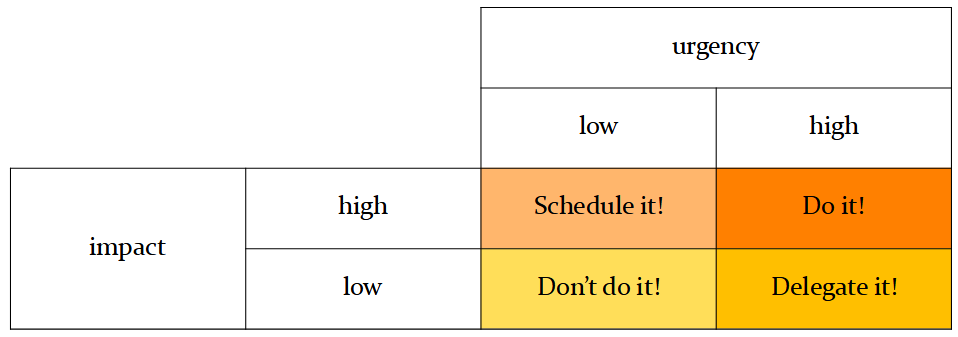
If you are faced with a task that is really important because it has high stakes or will make a big impact, and if the deadline to complete the task is fast approaching, then you should rank that task as your top priority, and do it immediately.
If another task is also of high value, but the deadline for completing it (if such a deadline exists at all) is at some time in the farther off future, then you should place that task into your calendar, and schedule to do it later. When the time comes, the task will move into the top priority.
Conversely, if the task is of low value but the deadline is nigh (immanent), or otherwise requires your constant attention, then you should try to delegate the task to someone (or something) else. Delegation is really nothing more than paying someone else to do the task for you, because you believe that your time would be more valuably spent doing something else (namely a high impact task). If you don’t have staff to assign the task to, then you might consider outsourcing it.2 Or, even better, you might try automating the task — I mean, what is automation if not delegation to a computer.
And if the task you are faced with is not important, because it has low stakes or will not make any impact, and does not have any pressing deadline, then you should place that task at the very bottom of your list of priorities, and even consider not doing it at all.
There is, however, a problem with the Eisenhower Box: it is not immediately clear how to define the vertical scale of impact. Yes, impact is important. But what exactly does that mean?
Urgency is easy to understand: a task that is due in one hour is more urgent than a task that is due in two hours, which in turn is more urgent than a task that is due in one day, which in turn is more urgent than a task that is due in one week, and so on.3
But what specifically makes one task of greater impact than another? How specifically does a task have high, or low, stakes? What is the underlying scale of value?
Any scale of impact, stakes, value, or importance must be an ordinal scale. We can specify which tasks have more or less impact, but we cannot say by how much. A 4-star rating is not really twice as much as a 2-star rating. If it were, you could eat at two 2-star restaurants, and then claim that the experience was as good as eating at a single 4-star restaurant. Or you could claim that performing a 1080 (three full revolutions while airborne) on a skateboard is a mere 20% harder than performing a 900.4
Personally, I find it useful to think of differences in the amount of impact a task might have in log terms rather than linear terms: a low value task would score 1; a more valuable task would score 10; a still more valuable task would score 100; and the most impactful and high stakes of all tasks would score 1000. (Of course, this is all still ordinal.)
I do not think there is a single definition of impact that would be suitable for everyone. We all differ in terms of what we hold most dear, what we value, and what our goals in life are.
Ikigai is an interesting framework for helping people realise and understand what they value most in their life.5
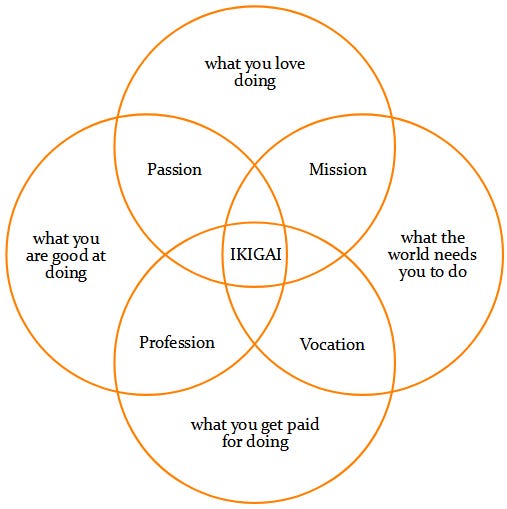
People who value what they get paid for doing would measure the impact of a task in terms of money: the greater the impact of the task, the greater the amount of money they would receive for completing it. But people who value what they are good at doing would measure the impact of a task in different terms, such level of difficulty: a skateboarder would rank the performance of a 1080 higher than a 900, because it is just so much harder to do.
Even more interestingly, if I rotate the ikigai diagram 180° and tweak the terminology to better reflect the world of business, I can produce something that looks very much like a balanced scorecard.
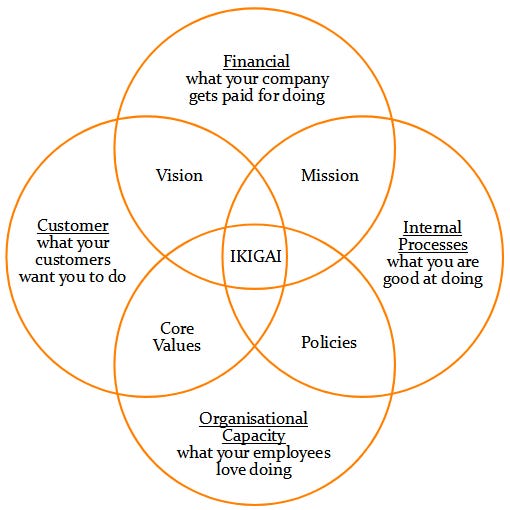
So, the impact/ stakes/ value/ importance of any task undertaken by a person or company most concerned with the top circle could be measured on a scale of financial performance.6 Impact in the left circle could be measured on a scale of customer satisfaction. Impact in the right circle could be measured on any number of scales relevant to internal business processes such as efficiency or productivity. And impact in the bottom circle could likewise be measured on any number of scales such as employee engagement or innovation performance.
So far, I have focused on the impact scale. But each compartment in the Eisenhower Box is, in and of itself, a sufficient topic for additional exploration and training.
How to execute, and get things done
How to manage your time through proper planning and scheduling
How to effectively assign work to others via
Delegation
Outsourcing
Automation
How to not-do7
Although attributed to Dwight D. Eisenhower, he himself attributed the method to a certain former college president, whom he neglected to name. See “What Is Important Is Seldom Urgent and What Is Urgent Is Seldom Important” at https://quoteinvestigator.com/2014/05/09/urgent/.
Tim Ferriss, of The 4-Hour Workweek fame, experimented with some extreme examples of outsourcing life, to see how far he could push the concept: the one I recall most vividly was when he outsourced his online dating activities. See https://tim.blog/2007/07/24/mail-your-child-to-sri-lanka-or-hire-indian-pimps-extreme-personal-outsourcing/.
Or perhaps urgency is not so easy to understand. As Ted Bauer observes: “Many organizations are bad at establishing clear priorities.” Also: “The connector between ‘unclear priorities’ and ‘work stress’ should be evident, but what drives it along is managers who declare everything ‘urgent’ regardless of whether it is or not.” And: “Human beings, as a general rule, don’t manage their time well.” See https://thecontextofthings.com/2017/08/30/eisenhower-matrix/.
Intersecting with urgency is the length of time required to complete a task. If you have one hour until the deadline, but the task requires three hours, then you have a serious problem.
See “Skateboarder Gui Khury, aged 11, breaks long-standing record with 1080-degree turn” at https://www.bbc.com/sport/av/52620373.
“Ikigai” is a Japanese word that translates as “raison d’être”, which, oddly enough, is a French phrase used in English to mean “reason for being”.
Note that these scales, unlike what was stated above, are not necessarily ordinal, and might just as likely be interval or ratio.
“What you must do is not-do” sounds like a Zen koan. Pondering it may or may not bring you insight. But practicing it can certainly free up a lot of time and energy in your day for you to do other more important things.